


Water Heater Replacement in Tampa
Water heater replacement in Tampa means taking out a tank that's done and installing one sized for the house. If you're still deciding whether the old one can be fixed, start with water heater repair. If the tank is leaking from the base or it's past 10 years old, keep reading.
A swap looks simple. Unhook the old tank, set the new one, hook it up. Most of the work is in the details around it: the expansion tank, the relief line, the pan, the gas venting, the breaker size, and the permit. Those decide whether the new heater lasts or fails its inspection. Titan has been a family-owned Tampa plumber since 1994, and we hold both the plumbing and electrical licenses, so one crew does the whole job.
When Water Heater Replacement Beats Another Repair
Three things settle it most of the time: the tank's age, where the water is coming from, and how many times you've already paid to fix it.
Age is printed on the rating plate, usually coded into the serial number. Tampa's hard water shortens tank life, and a tank here often lasts 8 to 12 years instead of the 12 to 15 you read nationally. Past 10, a new element or thermostat buys time on a tank that is already scaling inside.
Water at the base ends the discussion. The inner lining has failed, and no part fixes that. A drip at a fitting on top is different and can often be repaired. If you paid for one part this year and another just failed, put that money toward a new unit.
- Water pooling under the tank or rust at the bottom seam
- Rusty or brown hot water from an older tank
- Rumbling or popping that a flush no longer quiets
- Hot water running out sooner every month
- A second major repair in about a year
Choosing the Right Size Water Heater
Most Tampa houses run 40 or 50 gallon tanks. Bigger families and homes with a soaking tub go to 60 or 80 gallons. The number on the side matters less than the first-hour rating, which is how many gallons of hot water the heater can deliver in one busy hour starting from a full tank. It's printed on the yellow EnergyGuide label.
To size it, picture your worst morning. Two showers back to back, the dishwasher, maybe a load of laundry. Add up that hot water and pick a heater whose first-hour rating covers it. An electric tank recovers more slowly than a gas tank of the same size, so an electric household sometimes needs one size up.
Bigger isn't automatically better. An oversized tank keeps heating water nobody uses. And a 1950s or 1960s block home in Seminole Heights or Sulphur Springs often has a closet that won't fit an 80 gallon tank without moving walls, so we measure the space before we recommend anything.
- 40 gallon: one or two people, one bathroom
- 50 gallon: three or four people, two bathrooms
- 60 to 65 gallon: larger households, or a big tub
- 80 gallon: five or more people, or a heat pump model where extra storage covers slower recovery
Gas vs Electric vs Heat Pump vs Tankless
Staying with the fuel you have is usually the cheapest water heater installation. Switching fuels changes the job.
Electric tanks are the most common in Tampa. They need a dedicated 240 volt circuit and no venting. Gas tanks recover faster and need a gas line, a sediment trap, and a properly sized vent. Going from electric to gas means running gas pipe and a vent. Going from gas to electric can mean a new circuit or more panel capacity.
Heat pump water heaters, also called hybrids, pull heat from the air around them, and Tampa's warm garages suit them well. They're taller and heavier than a standard tank, they need open air around them, and they produce condensate that has to drain somewhere.
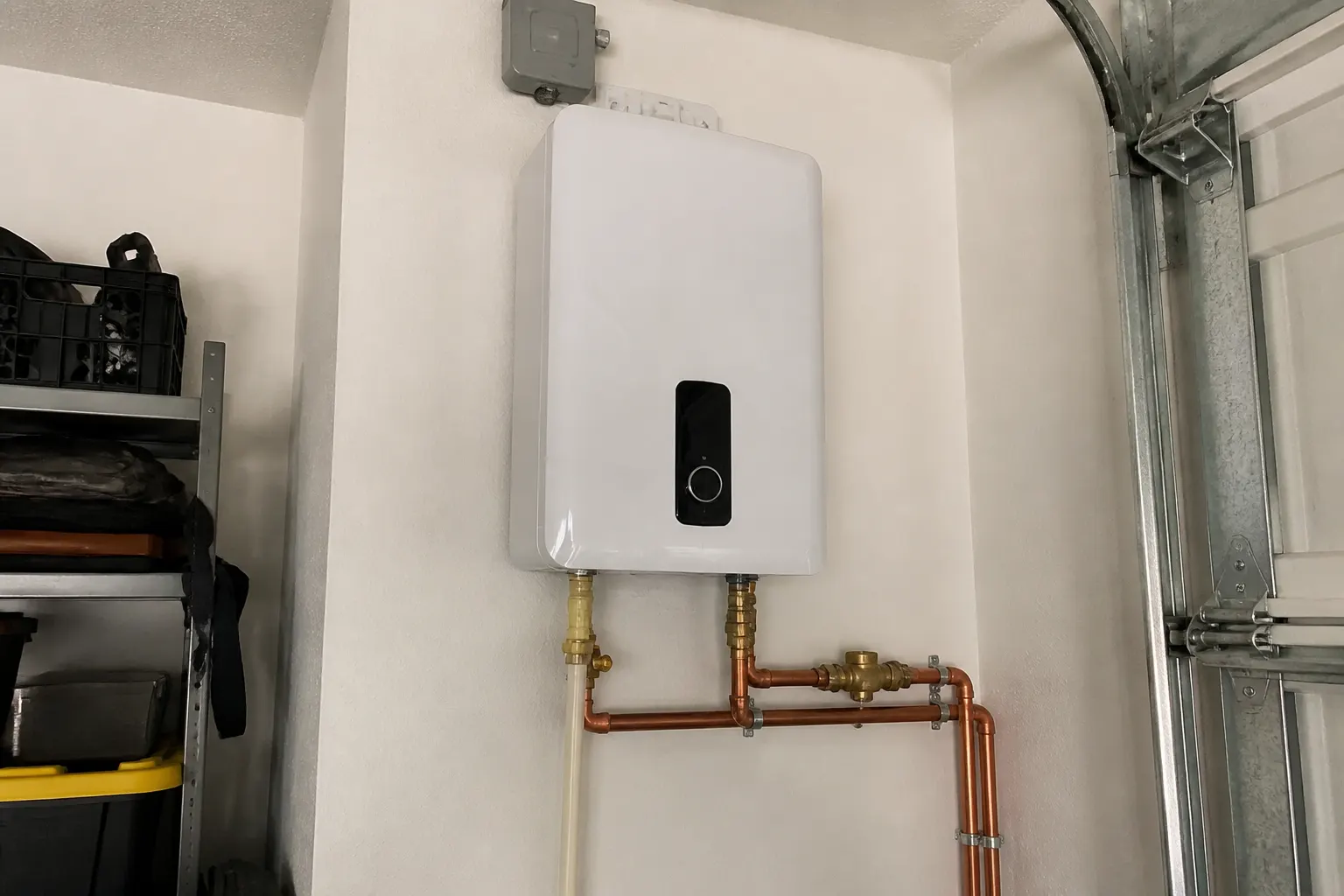
Tankless units heat water as it flows and hang on a wall instead of taking up floor space. Gas tankless needs larger gas pipe and its own vent. Electric tankless needs a lot of electrical capacity. Our tankless water heater page covers sizing, and the Optimal tankless page covers the electric model we're authorized to install in Tampa.
- Electric tank: simplest swap, needs a 240 volt circuit
- Gas tank: faster recovery, needs venting and a gas line sized for it
- Heat pump: lowest running cost of the tank types, needs space, airflow, and a condensate drain
- Tankless: no storage tank, sized by flow rate and temperature rise
What a Titan Water Heater Replacement Includes
A cheap quote usually leaves out the parts that make the install legal and safe. Ours lists them in writing before we start.
- Permit pulled and inspection scheduled
- Old tank drained, removed, and hauled away
- New water supply connectors, and a new shutoff valve if the old one is seized
- Thermal expansion tank on a closed system, meaning a home with a check valve or backflow device at the meter
- Temperature and pressure relief valve piped to an approved termination point, not left open over the floor
- Drain pan with a drain line when the heater sits indoors or in an attic, where a leak would cause damage
- On gas units, a new gas connector, a sediment trap at the inlet, and a vent checked for size, slope, and clearances
- On electric units, wire size and breaker checked against the new heater's rating
- Fill, purge, light or power up, and a temperature check at the tap
Do You Need a Permit to Replace a Water Heater in Tampa?
Yes. The City of Tampa lists water heater replacement as plumbing trade permit work, as long as the new heater goes in the same location with no fuel conversion. Moving the heater or switching fuels, like gas to electric, falls outside that trade permit and needs a full building permit with plan review.
Hillsborough, Pinellas, and Pasco counties and their cities issue their own plumbing permits, and the rules vary by jurisdiction. We pull the right one for your address. An unpermitted install can come up when you sell the house or file an insurance claim after a leak.
Strapping and Anchoring a Water Heater in Florida
Earthquake straps show up in a lot of online install guides because California and other seismic regions require them. Florida's code has dropped those seismic provisions, so straps aren't a standard requirement on a Tampa replacement. What matters here is a level, solid base, a pan where code calls for one, and secure gas and vent connections. If your jurisdiction or the manufacturer's instructions call for more, we follow them.
What Happens on Water Heater Replacement Day
A same-location tank swap usually takes a few hours. Fuel changes, relocations, and tankless conversions take longer, and we tell you that when we quote.
- We confirm size, fuel, and location, and give you the flat rate in writing.
- We shut off the water and the power or gas, drain the old tank, and disconnect it.
- We carry the old tank out and protect the floor on the way.
- We set the new heater in its pan and connect the supply lines, expansion tank, and relief line.
- On gas, we connect the gas line, install the sediment trap, attach the vent, and leak-test. On electric, we check the wiring and breaker.
- We fill the tank and purge the air before power or gas goes on. An electric element that fires in an empty tank burns out in seconds.
- We check the temperature at a fixture, show you the shutoffs, and leave the paperwork for the inspection.
Water Heater Replacement Cost in Tampa
HomeAdvisor's June 2026 national figures put most water heater replacements between $882 and $1,826, with an average of $1,348. HomeAdvisor lists tankless installs at $1,400 to $3,900 and hybrid heat pumps at $1,200 to $3,500. Those are national numbers, not a Titan price.
Titan quotes a flat rate after we see the install. The number covers the unit, labor, permit, and haul-away, so you can compare it to another quote line by line. These are the things that move it on a Tampa job:
- Tank size and fuel type
- Gas venting that has to be redone, or a fuel switch
- An expansion tank where none exists
- Attic, closet, or tight installs that need a pan, drain line, or extra labor
- Relocating the heater, which also changes the permit
- Panel or circuit work for a heat pump or electric tankless

Water Heater Brands We Install
We install Rheem, A.O. Smith, Essency, and GE tank water heaters, and we're the authorized Tampa installer for Optimal electric tankless, rated at 99% efficiency with a 25-year residential warranty.
We recommend the model that fits your closet, your fuel, and your water instead of pushing one brand. Every manufacturer writes installation requirements into its warranty, so the expansion tank, relief line, and pan go in with every brand we install.
Protecting the New Tank From Tampa Hard Water
City of Tampa water runs roughly 7 to 10 grains per gallon. The minerals settle at the bottom of the tank and harden into scale, and that is the main reason tanks here die early. A new heater on the same water gets the same result.
- Flush the tank once a year
- Check the anode rod every few years and replace it before it's gone
- Add a water softener so scale never reaches the tank
- Consider whole-home water filtration if an older home still has galvanized lines that shed rust
Relocating a Water Heater
Plenty of older Tampa homes have the heater in a hall closet, a utility room in the middle of the slab, or the attic. Moving it to the garage frees up space and keeps a future leak out of the living area.
A relocation means new water lines, new power or gas, new venting for a gas unit, and in the City of Tampa a full building permit instead of a trade permit. If we're already running new lines during a repipe, that's the easiest time to move the heater too.
Registering the Warranty
Most manufacturers ask you to register a new water heater within a set window after installation, and the terms vary by brand. We leave the model and serial number with you and can help you register it.
Keep the permit record and receipt with the warranty paperwork. If you ever file a claim, the manufacturer will want proof of a professional install.