

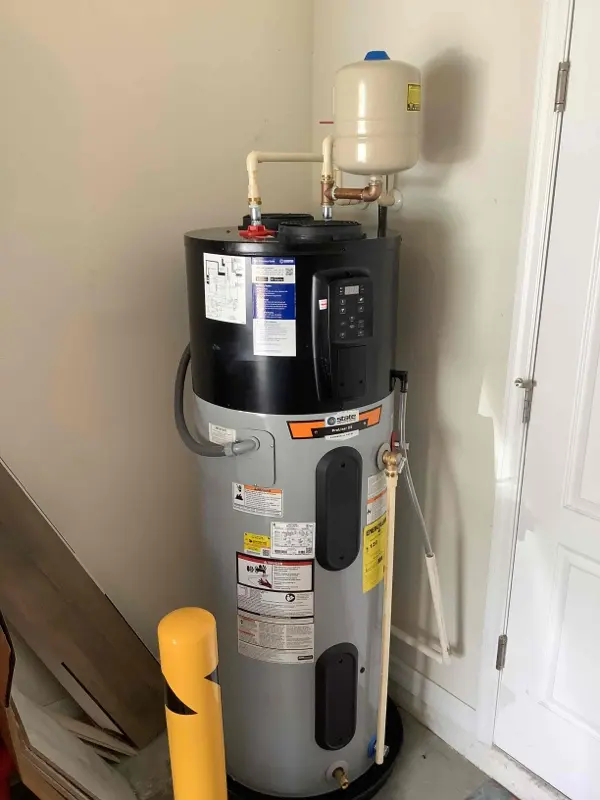
A heat pump water heater, often called a hybrid, stores hot water the way a regular tank does and pulls heat out of the air in the room. It is not a tankless heater. The photo at the top is a hybrid water heater replacement Titan did in Brandon. That is a real job photo of this type of heater.
The install scope is on heat pump water heater installation. Replacement of whatever is there now, tank or otherwise, is on water heater replacement. Service on an existing tank is on water heater services.
Call (813) 933-8010. Monday through Saturday. Closed Sunday. Plumbing license CFC1430231.
How does it work?
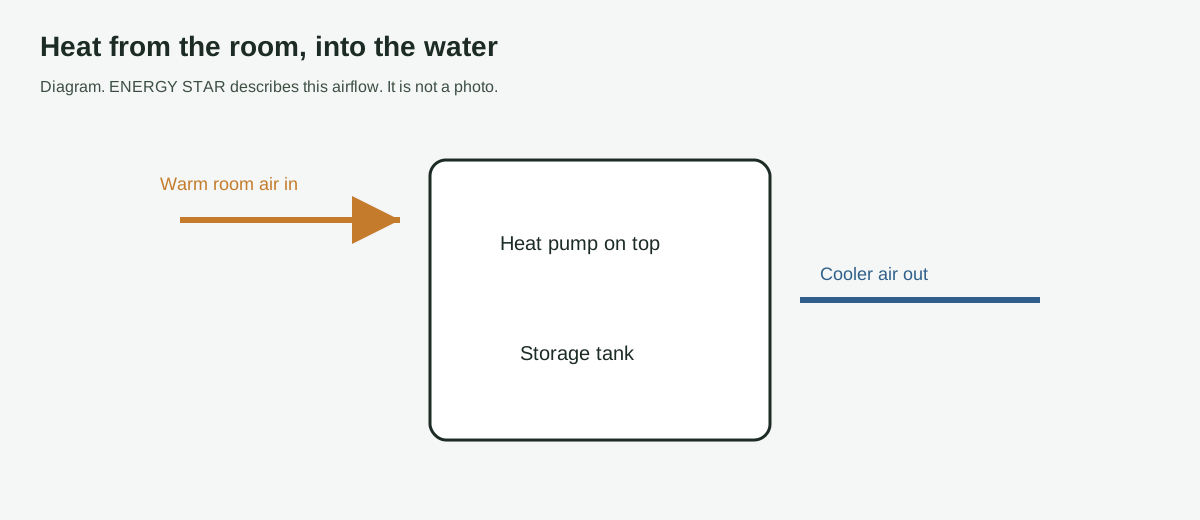
A fan pulls room air across a refrigeration circuit. Heat moves from that air into the water. The air that leaves the unit is cooler and drier. When the room is warm, the heat pump does most of the work. Electric elements are still in the tank for recovery when the air is cool or the house is drawing a lot of hot water at once. ENERGY STAR’s technical guide, updated June 2024, is the source for the airflow, the room volume, and the condensate rules below. ENERGY STAR heat pump water heater technical guide.
We are not printing a dollar saving. The guide says warmer air makes the heat pump more efficient. It does not give us a Tampa electric bill to quote, and we will not invent one. Your bill moves with the rate, the set temperature, how many showers you take, and whether the elements are doing the work. Anyone who promises a percentage off your bill from this page is ahead of the facts.
The tank still holds water, so sediment is still a tank problem. Tampa’s hard water is why we cut tanks open on camera. A heat pump heater does not remove that chemistry from the supply. If the old tank is full of scale, say so when you call. Filtration is a separate conversation from which heater you buy.
Does it work in Tampa’s climate?
The guide says integrated heat pump water heaters are designed for spaces with ambient temperatures from about 40 to 120 degrees Fahrenheit. Garages, basements, laundry rooms, and closets with louvered doors are on that list. The warmer the air, the more efficient the operation. The unit should be protected from the weather.
On garages, the same guide says uninsulated garages are acceptable in warmer climates where outdoor temperatures are usually above 50 degrees Fahrenheit. Tampa is that kind of climate for most of the year. A garage that actually drops near freezing on a rare night is a question for the manual of the model, not a slogan. The guide also says intake air below about 40 degrees pushes the electric elements on and cuts efficiency. We do not claim a Tampa garage never sees 40 degrees. We claim the published guidance treats a warm-climate garage as a normal place for this heater when the air stays in that band.
Cool exhaust is part of the machine. ENERGY STAR says not to put the heater where people will mind cooler air, and that a laundry room, garage, or utility room is a better spot than a room you sit in. Sound is compared in the guide to a dishwasher, about 45 to 55 dBA. A bedroom wall is a bad neighbor for that. A garage is the spot we see most often on Tampa replacements, which is why the room measurement matters more than the brochure photo of a basement. Many Tampa houses do not have a basement.
What space, drain, and airflow does it need?
Manufacturers typically want 450 or 700 cubic feet of free air, plus room to service the unit. The guide’s example is an 8-foot by 12-foot room with an 8-foot ceiling. If the heater is going into a small closet, a full louvered door can pass air to a larger room. If you use grilles, the guide says a total of 240 square inches of free area, which means the openings between the fins, with one grille high and one low. Ducting the intake or the exhaust is the other option. Do not duct both intake and exhaust outdoors in a cold climate. Tampa is not that case, and we still follow the manual for the model rather than inventing a duct layout on the phone.
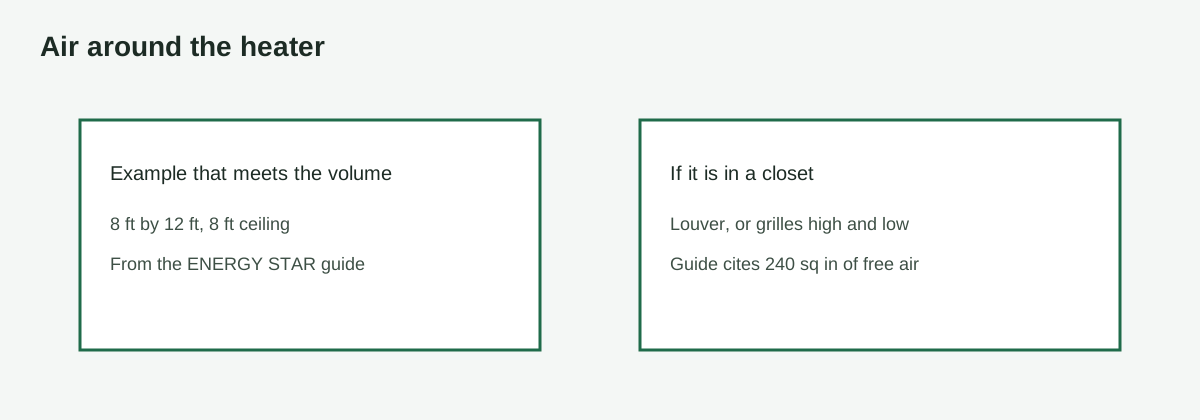
Measure before you buy. Multiply length, width, and ceiling height in feet. The guide’s typical minimums are 450 and 700 cubic feet. Its example room is 8 by 12 feet with an 8-foot ceiling, which is 768 cubic feet. A closet that is 3 by 3 feet with an 8-foot ceiling is 72 cubic feet. That closet misses the free-air number unless a louver or grilles open it into a larger room. Count the holes in a grille, not the frame around them. The guide’s figure is 240 square inches of free area, one opening high and one low.
Measure the doorway in the same trip. The tank has to pass through it. A hybrid is taller than many short electric tanks it replaces, because the heat pump sits on top of the storage tank. If a shelf, a dryer vent, or the door swing blocks the path, we say so before the unit is ordered. Service clearance is the clearance printed in that model’s manual. We do not invent one on the phone.
The tank is still a storage heater. We still pipe a temperature and pressure relief valve to a safe discharge, the same as on any tank we set. The heat pump on top does not remove that valve.
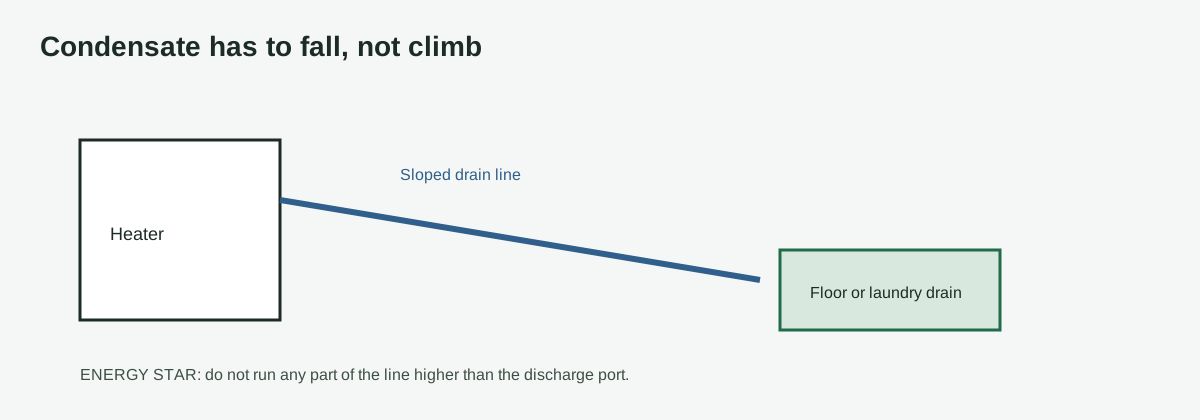
Condensate is clean water, not the acidic water a condensing gas heater makes. The guide says there is no special treatment, only a pipe to a drain. The line works by gravity. No section of it should sit higher than the discharge port on the heater. Acceptable drains in the guide include a floor drain, trench drain, mop sink, hub drain, standpipe, utility sink, or laundry sink. It says not to dump condensate straight into drain-waste-vent piping, and not into the safety pan under the heater. If the heater sits in a garage with no floor drain, a condensate pump, the same idea as an air conditioner pump, can lift the water. One pump can serve more than one appliance.
The electrical circuit has to match the heater. A hybrid that can fall back on elements is not a lamp cord. If the panel is full, that is an electrical visit under EC13012958, not a reason to skip the breaker size in the manual. We look at the panel before we set the heater.
What changes on the bill?
Less electricity when the heat pump is doing the heating and the room is warm. More electricity when the elements carry a long recovery. We will not translate that into dollars. The guide does not publish a Tampa bill, and neither do we.
Set the temperature where you actually want it. Turning it up to “make the heat pump worth it” just asks the elements to work harder. If the old tank was set high because sediment had stolen capacity, a new heater does not need that workaround. We set it at the install and show you the mode the manufacturer expects, including any high-demand mode that forces the elements.
Heat pump or tankless?
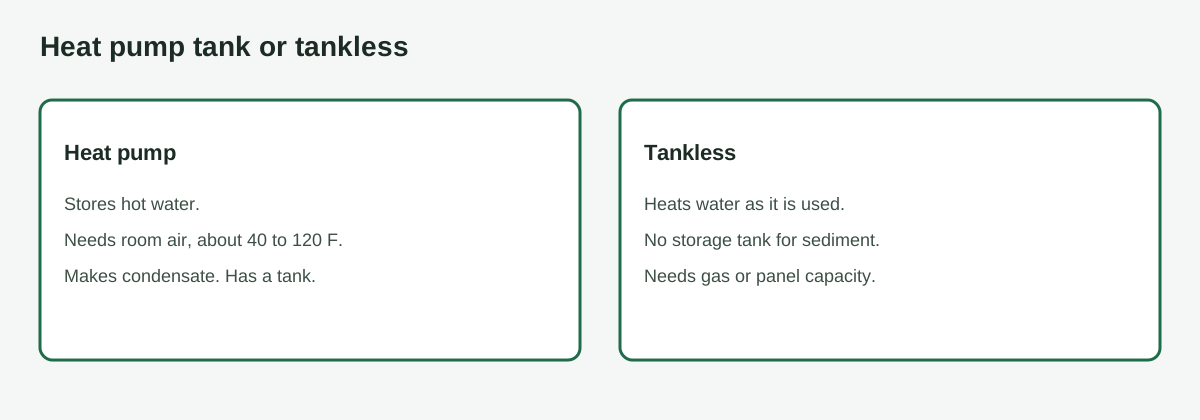
A tankless heater has no tank. Sediment does not sit in a 40- or 50-gallon reservoir. It needs enough gas or enough electrical capacity at the moment someone showers. A heat pump heater keeps a tank, needs the air volume above, and makes condensate. If the closet is a closed box with no louver and no drain, tankless or a standard electric tank may fit when the hybrid does not. If the garage is large, warm, and has a place for condensate, the hybrid is the conversation. The choice is on site. Tankless water heaters are the other page. We do not pick from a table of prices in this post.
Is there a tax credit?
For a heater placed in service after December 31, 2025, no. The IRS page on the energy efficient home improvement credit says the credit applies to qualifying property placed in service on or after January 1, 2023, and before December 31, 2025. Heat pump water heaters were in the group that could qualify for up to $2,000 a year while the credit existed, with labor included, on a primary home. Source: IRS, Energy Efficient Home Improvement Credit.
The IRS also published a table after Public Law 119-21. Section 25C terminates for property placed in service after December 31, 2025. Source: IRS FAQs on those credit changes. This post is dated November 2026. A new install now is after that date. We will not tell you to file a credit that the IRS says is closed.
We looked for a Florida rebate we could link as open today. We are not confident enough to name an amount or a program, so this post does not. If a utility or the state opens one, it will have its own page. Until then, the decision is the room, the drain, the circuit, and the flat rate after we see the install.
Call (813) 933-8010. Monday through Saturday. Closed Sunday.
Common questions
Does a heat pump water heater work in Tampa?
ENERGY STAR says these heaters are built for room air from about 40 to 120 degrees Fahrenheit, and that warmer air is more efficient. A Tampa garage that stays above about 50 degrees is the kind of warm-climate garage the guide calls acceptable. The manufacturer's manual still controls the model you buy.
How much air does it need?
The ENERGY STAR technical guide says manufacturers typically want 450 or 700 cubic feet of free air. An 8-by-12-foot room with an 8-foot ceiling is the example they give. A closet needs a louver or grilles. The guide cites 240 square inches of free area, high and low, when grilles are used.
Where does the condensate go?
It is water, not the acidic condensate from a gas heater. ENERGY STAR says to pipe it downhill to a floor drain, laundry sink, or similar drain, and not to run any section of the line higher than the outlet. A condensate pump is the fallback when gravity will not work.
Is the federal tax credit still available in 2026?
No, for a heater placed in service after December 31, 2025. The IRS says the section 25C energy efficient home improvement credit is not allowed after that date. We are not quoting a Florida rebate, because we have not confirmed one that is open.
Heat pump or tankless?
A heat pump heater stores water and borrows heat from the room. A tankless heater has no tank and needs enough gas or electrical capacity at the tap. The right one is the one the room, the drain, and the fuel can support. We quote a flat rate after we see the closet.
Need help with this?
Talk to a real Tampa dispatcher.
Same-day service, flat-rate pricing, A+ BBB rated.