

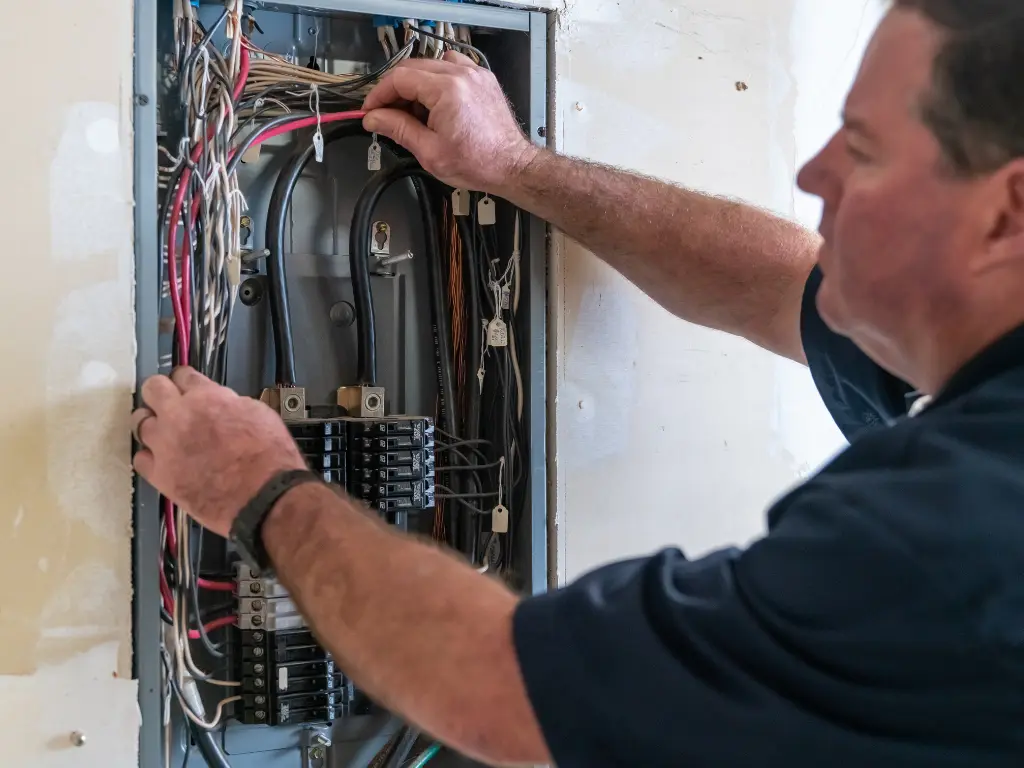
If your circuit breaker seems more trigger-happy during the summer months, you are not imagining it. Florida’s heat and humidity create conditions that push home electrical systems harder than almost any other season. Understanding what is behind the trips can help you figure out when it is a minor inconvenience and when it points to something that needs professional attention.
What a Circuit Breaker Actually Does
Your circuit breaker is a safety device, not a power manager. Its job is to cut off electricity when a circuit carries more current than it was designed to handle. That excess current generates heat, and heat left unchecked can start fires. When a breaker trips, it is doing exactly what it was built to do — protecting your home from an electrical fault.
Circuit breakers are rated for a specific amount of current, measured in amps. When that threshold is exceeded, a mechanical switch flips to interrupt the flow. The reason you may notice it more in summer comes down to how heat and humidity affect both the wiring in your walls and the appliances pulling power from those circuits.
Why Summer Is Harder on Your Electrical System
Florida summers push a home’s electrical system in ways that other seasons simply do not. When outdoor temperatures stay above 90 degrees for weeks at a time, the air conditioning unit runs almost constantly. Add in the extra load from pool pumps, outdoor lighting, and fans, and you have circuits that were installed for everyday use suddenly handling demands they were not necessarily sized for.
The heat inside your home matters too. If your electrical panel is located in a garage, laundry room, or anywhere without climate control, the ambient temperature around those breakers can push them over the edge. Breakers are rated to operate up to a certain temperature, and when that threshold is exceeded, they can trip at lower loads than their stated rating.
The Three Most Common Reasons a Breaker Trips
1. Overloaded Circuit
This is the most common cause. An overloaded circuit happens when too many devices are drawing power from the same outlet or circuit at the same time. During summer, this becomes more likely because items like air conditioners, dehumidifiers, and window fans may all be running simultaneously on circuits that were designed for normal household use.
If the breaker trips when you plug in a particular appliance or when multiple things are running at once, an overload is the most likely culprit.
2. Short Circuit
A short circuit is more serious. It occurs when a hot wire touches a neutral wire or ground, creating a sudden and large jump in current flow. The breaker responds immediately and forcefully when this happens, and it will typically trip faster than it would for an overload.
Signs of a short circuit include a burning smell near an outlet, scorch marks on a switch plate, or a breaker that trips immediately after being reset. If any of those signs are present, it is time to call an electrician before using that circuit again.
3. Ground Fault
A ground fault is similar to a short circuit but involves current taking an unintended path to ground — usually through a person or through moisture. Bathrooms, kitchens, garages, and outdoor outlets are the most common locations for ground faults because these are the areas where water and electrical outlets are most likely to meet.
In Florida’s humid climate, ground faults become more common as moisture finds its way into boxes and conduit. This is one reason why GFCI outlets are required in certain areas of the home, and if you do not have them in places like your garage or outdoor patio, that is worth looking into.
Why Does My Breaker Keep Tripping After I Reset It?
If a breaker trips once and resets fine, it was likely a temporary overload. If it trips again immediately or shortly after being reset, the issue has not resolved itself. Common reasons for repeated trips include:
- A circuit breaker that has worn out over time and is now tripping at lower-than-rated loads
- A faulty appliance that is drawing excessive current even at idle
- A wiring issue somewhere in the circuit that has developed over time
- A newly added appliance — like a larger window air conditioner — on a circuit that was already near capacity
If resetting the breaker does not hold, the problem is still present and should be looked at by a licensed electrician.
When It Is Time to Call an Electrician
Some breaker trips are DIY situations — unplugging a few things and redistributing the load is something any homeowner can handle. But there are situations that call for a professional, especially when safety is on the line.
Call an electrician if your breaker trips repeatedly, if you smell burning near the panel, if the panel itself feels warm to the touch, if you see discoloration on outlets or switches, or if you have an older home with a panel that has not been inspected in several years. An aging panel in a hot climate like Tampa can develop issues that are not visible from the outside but can pose real risks.
Our team handles circuit breaker panel installation and upgrades throughout the Tampa area. If your panel is old, warm to the touch, or tripping frequently, it is worth having it looked at before the worst heat of summer arrives.
Services We Offer
When it comes to your home’s electrical system, taking a reactive approach — waiting for something to fail before addressing it — can end up costing significantly more than addressing the root cause early. Our electrical team provides a full range of residential services to keep your home safe and functional:
- Circuit breaker panel inspection and replacement — If your panel is aging or showing signs of strain, we can assess whether a repair or full replacement makes more sense for your situation.
- Emergency electrical repair — For urgent situations like burning smells, sparking outlets, or breakers that will not reset, our emergency team is available to respond quickly.
- Whole-home surge protection — Florida’s summer storms bring power surges that can damage appliances and electronics. Surge protection installed at the panel level guards everything in your home at once.
- Electrical safety inspections — Particularly valuable for homeowners who have not had their electrical system professionally reviewed in several years, or for anyone who has added major new appliances recently.
- Outlet and wiring repair — From replacing outdated two-prong outlets to troubleshooting faulty wiring, we handle repairs across all areas of the home.
You can learn more about our full range of electrical services or contact us directly to discuss what your home may need.
Areas We Serve
We are a local company with deep roots in the Tampa Bay area. Our electricians serve residential customers across a wide footprint, covering the communities where most of our service calls come from. Whether you are in the city or in a surrounding suburb, we have crews familiar with the types of homes and electrical systems common to each area:
- Tampa
- Carrollwood
- New Tampa
- Lutz
- Odessa
- Land O’ Lakes
- Citrus Park
- South Tampa
- Westchase
- Temple Terrace
- And all surrounding communities
Not sure if we cover your area? Our full service area listing has the details, or you can reach out and we will confirm right away.
FAQ — Circuit Breaker Tripping in Summer
Is it dangerous if a circuit breaker keeps tripping?
Occasional tripping due to a temporary overload is not immediately dangerous — the breaker is doing its job. However, if a breaker trips repeatedly, feels warm, or trips immediately after being reset, that points to an underlying problem that should be evaluated by a licensed electrician. Ignoring a malfunctioning breaker panel is not worth the risk.
Why does my breaker trip more often in summer?
Summer puts more demand on your electrical system. Air conditioning, dehumidifiers, and other cooling equipment run constantly, and Florida’s high outdoor temperatures raise the ambient heat around your electrical panel. Both factors can cause breakers to trip at loads that would be fine during milder months.
How many times can a circuit breaker trip before it needs to be replaced?
There is no exact number, but breakers are mechanical devices that wear out over time. If a breaker has tripped frequently — particularly if it now trips at lower loads than it used to — it may be nearing the end of its service life. An electrician can test it and determine whether replacement is needed.
What should I do if my circuit breaker will not reset?
If resetting the breaker does not hold, stop trying to force it. Unplug items from that circuit and try again. If it still will not hold, do not use the circuit until an electrician has assessed it. Call us for same-day service if the situation feels urgent.
Can a circuit breaker trip without anything being plugged in?
Yes. The issue could be in the wiring itself — a short, a ground fault, or deteriorated insulation somewhere in the circuit. This is one of the more serious scenarios and should be addressed by a professional rather than investigated on your own.
Does a frequently tripping breaker mean I need a panel upgrade?
Not always. Sometimes redistributing loads, replacing a faulty appliance, or upgrading a single breaker is enough. However, if your home has an older panel — particularly one that is warm to the touch or makes a buzzing sound — a panel upgrade may be the most practical long-term solution.
Need help with a circuit breaker issue in your Tampa-area home? Our electricians are standing by. Contact us online or call and we will have someone out to take a look. We serve homeowners throughout the Tampa Bay area and work around your schedule.
Titan Plumbing & Electric | Serving Tampa and surrounding communities | View all service areas
Need help with this?
Talk to a real Tampa dispatcher.
Same-day service, flat-rate pricing, A+ BBB rated since 1994.